
Car battery float charger
 Fast vs. Slow, Charge and Discharging
The storage capacity of a lead-acid (automotive type) battery is not fixed, but varies according to how slowly the battery is discharged. Similarly, the charge capacity of a battery is not fixed, but varies on how slowly a battery is charged. With batteries, the slower the charge the better!
When a battery is charged or discharged, this initially affects only the chemicals closest to the gap between the battery plates and the electrolyte. With time, the charge stored in the chemicals spreads by diffusion* of these chemicals throughout the battery.
* Diffusion describes the spread of particles through random motion from regions of higher concentration to regions of lower concentration.
Fast Charging
(Not the best for a battery)
If a battery has been completely discharged (e.g. the car lights were left on overnight) and next is given a FAST charge for only a few minutes, then during the short charging time there will only be a charge nearest the battery plates. Charging a battery too fast can also cause a dangerous condition called Thermal Runaway** If using a high-amperage battery charger (or even charger with monitoring electronics set to a high amperage setting), the charger's meter will falsely show that the battery is fully charged. Why? Because after a few hours this charge will spread to the volume of the plates and electrolyte, resulting in a charge that may be so low as to be incapable of starting a vehicle.
** Thermal Runaway is a very dangerous condition that can occur if batteries are charged too fast. One of the byproducts of Gassing are Oxygen and Hydrogen. As the battery heats up, the gassing rate increases as well and it becomes increasingly likely that the Hydrogen around it will explode.
 Slow Charging
(Best for the battery)
On the other hand, if the battery is given a SLOW charge using a low-amperage float charger, the charge will certainly take longer, but the battery will become more fully charged. During a slow charge, the charge current has time to distribute to the entire volume of the plates and electrolyte, while continuously being replenished by the battery float charger. The battery voltage will remain below the charger's voltage throughout the charging process allowing charge current to flow into the battery until the battery is truly fully charged, and the float charger stops charging the battery. Article continued below...
Fast Discharge
A similar occurrence happens when a battery is quickly discharged. We have all experienced the situation of continuously cranking the engine, trying to start our car. Eventually, the battery dies - so it appears. But when we come back an hour later, the battery has sufficient charge to crank the engine a few more times.
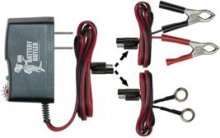 Why does this happen? If a battery is subject to a fast discharge (such as starting a car with a current draw of 100 amps or more) for a few minutes, the battery will appear to go dead. However, it may have only lost its charge nearest the plates. If the discharge is stopped for awhile, the battery may resume normal operation at the appropriate voltage and power.
Slow Discharge
On the other hand, if a battery is subject to a slow, deep discharge (such as leaving the car lights on, a current draw of 7 amps or less) for hours, then any observed reduction in battery performance will likely be permanent.
Charging Batteries
A charging battery is used in automobiles. These lead acid batteries are designed for starting automotive engines but not designed for deep discharge. They have a large number of thin plates designed for maximum surface area, and therefore maximum current output, but which can easily be damaged by deep discharge.
Repeated deep discharges will result in capacity loss and ultimately in premature failure, as the electrodes disintegrate due to mechanical stresses that arise from cycling. Starting batteries kept on continuous charge will have corrosion in the electrodes which will result in premature failure. Starting batteries should be kept on a charger that cycles on & off, with minimal amperage to prevent sulfation.
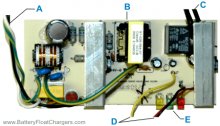 Starting batteries are lighter weight than deep cycle batteries of the same battery dimensions, because the cell plates do not extend all the way to the bottom of the battery case. This allows loose disintegrated lead to fall off the plates and collect under the cells, to prolong the service life of the battery. If this loose debris rises high enough it can touch the plates and lead to failure of a cell, resulting in loss of battery voltage and capacity.
Deep Cycle Batteries
Deep cycle batteries are used to power trolling motors, wheel chairs, forklifts, golf carts, marine and motorhome applications. Specially designed deep-cycle cells are much less susceptible to degradation due to cycling, and are required for applications where the batteries are regularly discharged. These batteries have thicker plates that can deliver less peak current, but can withstand frequent discharging. Battery float chargers also work ideally on deep cycle batteries.
Battery Butler
Battery Storage Chargers
How can I tell if a "new" battery is fresh?
Look for the small decal on the side of the battery housing. This sticker will tell you the month and year that the battery was shipped from the manufacturer. The more current the date, the fresher the battery.
The letter corresponds with the month, starting with "A" for January, "B" for February, etc. The number represents the year with "9" standing for 1999, "0" for 2000, and so on. A9, would be January, 1999. C0 would be March, 2000.( The letter "I" is skipped so the letter "M" would be December.)

|
PowerBear Qualcomm Quick Charge 3.0 Car Charger | 2-Port USB Car Charger [45W] Dual-USB Ultra Fast Car Charger USB [Qualcomm 3.0 Certified] - Black [24 Month Warranty] Wireless (PowerBear LLC)
|
Related posts:
 Coffee Cup Power Inverter ($34.99) ThinkGeek This doohickey looks like a cup of coffee and fits in your - you guessed it - cup holder. Do not fill it with coffee…
 Being pulled over by a police officer for speeding is the beginning of a series of unfortunate events that costs people money and time, at the very least. Smart…
 If you understand why car batteries fail, then you should also understand the importance of charging your car battery. On average, most batteries do not require…
 Q7 HUD GPS Head Up Display! Q7 HUD is specially designed for preventing accident, which can project important information ( e.g. vehicle speed ) onto the front windshield…
 This USB car charger is a great little unit. It comes in a small white box with the unit and the Quick User guide. The 4 ports mean that one can plug in their phone…
 @Sprint Gettysburg: Who likes a BOGO? We got em for you today!
Charging/data cables
Portable battery chargers
Car chargers
Tempered glass
Open until 9!
@Sprint Gettysburg: Who likes a BOGO? We got em for you today!
Charging/data cables
Portable battery chargers
Car chargers
Tempered glass
Open until 9!