
Dodge Charger Stock Car
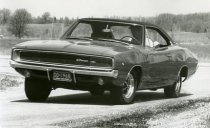 Chrysler Corporation, then, is flat-out in the automobile business again. The Marlin‑like Charger of the past (really a Coronet with a hastily added fastback roof), and the similarly makeshift Barracuda were grim reminders of the Corporation's close call with financial disaster in the early Sixties. But the belt-tightening policies of Lynn Townsend—Chrysler's chief executive since 1961, and more recently Board Chairman—combined with his intense efforts to improve and increase the Corporation's manufacturing facilities seem to be paying off. The 1967 Barracuda and the new Charger, each with its own distinctive sheet metal now, are evidence of Chrysler's increasing strength and ability to meet both the financial and creative challenge of the specialty car age.
Specialty cars are conceived from a significantly different planning philosophy than that of the bread-and-butter cars which Detroit used to build exclusively. Bread-and-butter cars are built with the primary intention of offending no potential buyer, rendering the cars largely featureless and unexciting. Specialty cars, on the other hand, are built to please specific groups of customers. We like the more positive philosophy behind the specialty car, and the Charger is chock-full of features with obvious appeal for the performance-minded enthusiast.
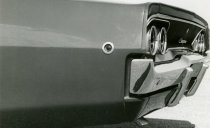 The aerodynamic appearance of the Charger (it's as aerodynamically slippery as it looks, according to Chrysler's engineers) is accented by a rear spoiler combined with a truncated rear end for a Kamm effect—a design approach which has become almost mandatory in modern racing cars. The Charger takes on the nose-down appearance common to both NASCAR and NHRA, and the bulging rear fenders should accommodate the racing tires used in both drag and stock car racing with a minimum of rework. The greenhouse, following the sharply curved side-glass, slants steeply towards the center of the car, very reminiscent of Le Mans Ferraris, particularly when viewed from the rear. A tunnel-type backlight is used instead of a pure fastback (a styling feature fast going out of fashion from over-use). The smaller rear window of the tunnel roof also gives much less distortion to rear vision than a steeply slanted fastback window.
Further visual performance identity is achieved by the use of a racing-style gas filler cap mounted high on the left rear quarter, and quasi fog/driving/parking and turn signal lights mounted low in the front bumper. Matte black paint is used extensively in the grille and around the tail lights. Full wheel cut-outs, fat tires on 6-inch rims, and simulated engine compartment exhaust vents in the hood (which also house turn signal indicator lights, like the Mustang GT) and at the leading edge of the doors complete the Charger's complement of visually "in" features.

|
Hot Wheels Thrill Racers-Race Course 2012 Dodge Charger Stock Car Toy (Mattel)
|

|
Hot Wheels 2010-169/240 Race World Speedway 01/04 Dodge Charger Stock Car 1:64 Scale 1:64 Scale Toy (Mattel)
|

|
Hot Wheels Team: Hot Wheels Racing Dodge Charger Stock Car Blue #146/196 Toy (Mattel)
|
Related posts:
 Coffee Cup Power Inverter ($34.99) ThinkGeek This doohickey looks like a cup of coffee and fits in your - you guessed it - cup holder. Do not fill it with coffee…
 Being pulled over by a police officer for speeding is the beginning of a series of unfortunate events that costs people money and time, at the very least. Smart…
 The circuit has been designed to construct a practical mechanism that can easily and automatically charge batteries rated at 6 V or 12 V used in automobiles. BC557…
 Q7 HUD GPS Head Up Display! Q7 HUD is specially designed for preventing accident, which can project important information ( e.g. vehicle speed ) onto the front windshield…
 This USB car charger is a great little unit. It comes in a small white box with the unit and the Quick User guide. The 4 ports mean that one can plug in their phone…
 @Alexander Basek: The car rental place gave me a white Dodge Charger for the week while my ride is getting fixed. Gonna pretend I'm Raylan from Justified.
 RT @OrlandoExpert: British Visitor's best start to a vacation. At Car Rental desk- Q:"Do you have a Dodge Charger for me?" A:" Yes I do" #o…