
Electric Car Charger installation
Advertisement - Continue Reading Below
Imagine never going to the gas station again. Such convenience is one of the key advantages of an electric vehicle, although it comes with two drawbacks: short range (sometimes less than 60 miles) and long charging times. Unless you can afford a $70, 000 Tesla Model S, which goes up to 300 miles on a charge, there's not much you can do about an electric vehicle's limited range. But you can improve the charging time by installing a Level 2 (240-volt) charger at home. For a pure EV, a Level 2 charger cuts the time it takes to replenish the battery from more than 18 hours with a 110-volt wall plug to as little as 3 hours. And for plug-in hybrids it means that instead of tapping into the fuel tank, you can restore the car's electric range after you get home from work and before you head out for a night on the town.
According to Mike Mueller, product manager at Bosch, "If you know how to install a 240-volt dryer outlet, you can install an EV charger." However, he goes on to explain the maze of electrical codes that govern such an installation. Put simply, this is probably a job for a professional electrician. The good news is that when you buy an EV or a plug-in, many electric utilities offer incentives that cover the cost of a charger and its installation. So, hiring a pro to do the work not only is easy but also potentially free. This job will require an inspection—another reason for having the unit professionally installed. Here are the key things you need to know to get your house EV-ready.
Pick Your Charger
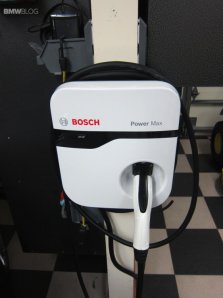
Aside from Teslas, EVs and plug-ins in the U.S. use the SAE-standard J1772 plug. Although they work about the same way, not all chargers are created equal.
Cost: Level 2 chargers range in price from just under $500 to more than $1000. The two biggest factors are amperage and cord length: If you want more, expect to pay more.
Installation Type: This unit is meant to be a permanent installation, mounted to the wall on a bracket. But some are classified (confusingly) as "permanently installed, removable" and use a standard plug so you can take the charger with you if you move.
Amperage: Level 2 chargers come in 16- or 30-amp flavors. A 16-amp charger works fine for plug-ins such as the Chevrolet Volt, which doesn't draw more current than that, and can often be installed with your existing wiring. But 30 amps should be your default, as it provides maximum charging speed and future-proofs your purchase if you buy a second electric vehicle.
Cord Length: The location of the charger in your garage will depend on how far you'll need to reach to access the car's charge port. A Nissan Leaf, for instance, is about 14½ feet long and charges from the nose. We recommend a spot close to the garage door, so you can charge your car even if you're parked in the driveway. A 16- or 18-foot cord should be fine, but go longer if you can afford it. These units can't be retrofitted if you've left yourself short.
What's So Special About That Plug?
The SAE J1772 charging plug is as inelegant as its name. And the five ports that connect to your car might seem complicated, but they're actually pretty straightforward.
Devon Jarvis
1 AC power, just like the power plug for your TV.
Proximity detection. This is simply a mechanical switch that makes sure you're plugged in all the way.
3 Ground wire.
4 Communications, used to relay data between the car and the charger about how much current is needed.
Get Your House Ready
The biggest potential headache with an EV charger is whether you have proper electrical service. If your house can't handle the extra load of a charger, you're dealing with an even bigger project of getting a new service drop, which means cutting off power to the house and installing a new meter and breaker panel. You'll also need to consider the age of your garage and its distance from the house. Old wiring going to the garage might need to be replaced, and longer distances can come with a nominal increase in the size and cost of the cable that runs to the charger. In most instances, though, an electrician will be able to properly wire to your garage. If you're experienced with home wiring, make sure you follow all the guidelines. Ignoring them carries a very real risk of an electrical fire. National Electrical Code Article 625 covers the rules for EV-charger installation, such as where a charger can be mounted and what kind of wiring is required. Check state and local codes as well.
If you don't have a garage, you can install a charger in your driveway. For outdoor mounting, you'll want a unit with a NEMA (National Electrical Manufacturers Association) rating of 4X—the Bosch Power Xpress is one example—which is made to stand up to rain, cold, and dust.

|
Electric Car Charger Installation - New Outlet Installation Services ()
|

|
Schneider Electric EV230WS EVlink 30-Amp Generation 2.5 Enhanced Model Indoor Electric Vehicle Charging Station Home Improvement (Schneider Electric)
|

|
JuiceBox Pro 75A WiFi-equipped Plug-in Electric Vehicle Charging Station with 24-foot cable and Input Whip for Hardwire Installation Automotive Parts and Accessories (JuiceBox)
|

|
Metra 40-CR10 Chrysler 2001-Up Car Antenna Adapter Car Audio or Theater (METRA Ltd)
|

|
Metra 99-6507 Single DIN Installation Kit for Select 2004-2008 Chrysler/Dodge/Jeep Vehicles Car Audio or Theater (METRA Ltd)
|
Related posts:
 Coffee Cup Power Inverter ($34.99) ThinkGeek This doohickey looks like a cup of coffee and fits in your - you guessed it - cup holder. Do not fill it with coffee…
 Being pulled over by a police officer for speeding is the beginning of a series of unfortunate events that costs people money and time, at the very least. Smart…
 If you understand why car batteries fail, then you should also understand the importance of charging your car battery. On average, most batteries do not require…
 Q7 HUD GPS Head Up Display! Q7 HUD is specially designed for preventing accident, which can project important information ( e.g. vehicle speed ) onto the front windshield…
 This USB car charger is a great little unit. It comes in a small white box with the unit and the Quick User guide. The 4 ports mean that one can plug in their phone…
 @Alexander Basek: The car rental place gave me a white Dodge Charger for the week while my ride is getting fixed. Gonna pretend I'm Raylan from Justified.
 RT @OrlandoExpert: British Visitor's best start to a vacation. At Car Rental desk- Q:"Do you have a Dodge Charger for me?" A:" Yes I do" #o…